Showing posts with label witches. Show all posts

10.26.2016

Reclaiming The Radical Legacy of The Witch


Article by 

“I’ve been doing a lot of thinking about witches. Not just because top ten lists of hot tv witches and sexy Halloween selfies currently swamp my social media feeds, but because my tables and shelves are currently so laden with herbs, plants, berries, phials and bottles that if an inquisitor of old were to enter, I’d find myself quickly tied to the stake. And while this worry seems remote, it’s a plain fact that women in third world countries are still hunted down, tortured and set aflame for the crime of witchcraft.

Sure, the witch is emerging from the world of taboo and shadows onto the world stage. Sure, she’s being touted as a feminist icon  – a “powerful feminine model free from male influence or ownership”. But I’m not so sure. Because how can it be that the witch, once associated with everything transgressive and beyond the realm of normative society, is now so trendy and positively mainstream?  Is it really a feminist step forward that W magazine declared Fall 2016, the season of the witch, replete with pouting models in gothic dresses, chains and black lace underwear?

And while many believe the witch of the middle ages was a spectre created by the church, I believe she was real. Yes, many put to death were just ordinary women who practiced folk magic, herbalism and midwifery, but many were powerful spiritual leaders of the indigenous, animist faith traditions of the old world – and their magic was earned through a lifetime of spiritual discipline spent in communion with nature.

And I worry her make-over into nubile fashion siren not only obscures this history, but her true relevance as a role model to us today. One that if resurrected, would be just as subversive and dangerous to the powers that be. 

Today the witches tall black hat and burbling cauldron have become icons of Halloween kitsch, but they were once hallowed items of the holy women and priestesses, the healers and herbalists, the oracles and diviners of old Europe. Their conical hats and cauldrons date back to the 2nd Millennium BCE and were connected to the female shamans of the Indo-European peoples.
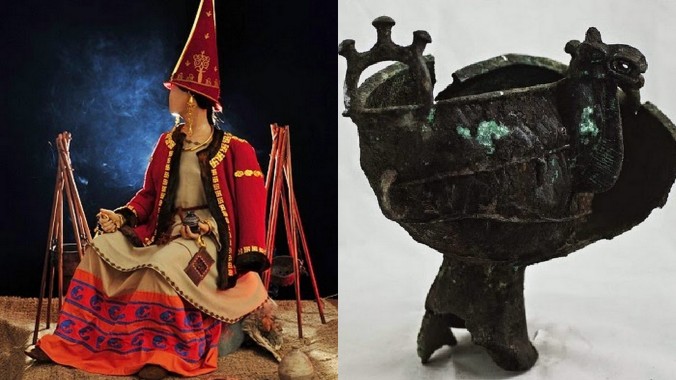


recently-updated247


Their cauldrons (as well as crystal balls and magical wands) were still being used thousands of years later by the “witte wieven” or wise women, the sibyls, seers, and female druids of Celtic, Anglo Saxon, and Norse traditions of the middle ages.

According to Max Dashu, author Witches and Pagans: Women in European Folk Religion,  these “dream-readers, sooth-sayers, and herb-chanters, fire-gazers in Switzerland, or water-gazers in France and Spain”, practiced “all the elements of shamanism: chants, prophecy, healing, weather-making powers, and shapeshifting”. Legends tell of their sacred cauldrons in which “they simmered mysterious herbs to produce a drink of immortality and resurrection.”

These women were the guardians of the earth, the protectors of the sacred groves, lakes and springs, from which they derived their magical power. And until the middle ages they were highly respected, sought out and consulted for healing and divination by common folk, nobility and clergy alike.

But according to Barbara G. Walker , it was during the 14th century that the Catholic Church, during its relentless expansion and appropriation of sacred land, began to distinguish between witchcraft, perpetrated by women, and sorcery, a legitimate pursuit of men.


witchwisewomen

While books on sorcery were condoned well into the enlightenment, female witches in contrast were said to “magically injure crops, domestic animals, and people, and in general “outrage the Divine Majesty”. And thus their religious practices (as described by Dashu) of “sitting-out” on the land “gazing, listening, gathering wisdom” were extinguished by a priesthood that sought to bring nature, magic, women (not to mention their land and property) under male control.

witchburn

These women did not go easily, or take usurpation of their holy sites and old ways lightly – it took the Church hundreds of years to hunt them down. And so it seems likely, at least to me,  that the stereotype of vengeful witch, casting curses and blighting crop, was real, at least for the church. She must have been the original eco-feminist, fighting the patriarchy with one of most powerful tools at her disposal, magic. And the Church took it pretty seriously indeed.”

3.19.2015

Wiccan Priestess Shares Tips For Urban Dwellers To Connect With Nature This Spring Equinox


Link:  http://www.huffingtonpost.com/2015/03/19/ostara-spring-equinox-celebrations_n_6897898.html

Great article! Here's some wonderful ways to spend tomorrow's Equinox:


"The spring equinox falls on Friday, March 20, in the Northern Hemisphere, marking the moment that the sun passes over the celestial equator. On this day, Wiccans and many other neopagans observe Ostara, a festival that celebrates the season's change from dark winter to brightening spring.
Wicca is a pagan religion that emphasizes the cycles of nature and spiritual connection to the earth. Ostara is one of 8 seasonal Wiccan holidays.
Faith tradition aside, though, there are ways all of us can connect more deeply with nature and reap the benefits of the new season, according to Wiccan priestess Selena Fox.
"Spring equinox is a time of new life, new growth, and renewal," Fox told The Huffington Post. "It is a wonderful time to get outdoors and commune with nature, watching migrating birds, the greening of the landscape and budding of trees."
Fox is the high priestess of Circle Sanctuary, a Wiccan church, resource center and nature preserve in southwestern Wisconsin. The preserve is situated amidst "rolling hills" with access to "forests, meadows, a remnant prairie, streams, springs, ancient sandstone rock outcroppings, nature trails, and an abundance of wild birds and other wildlife," according to its website.
Those who are city-bound and surrounded by concrete sidewalks and skyscrapers may be crying a bit on the inside after reading that. We feel your pain.
But Fox says there are actually many ways for urban-dwellers to connect with nature on Ostara. The priestess shared seven tips for celebrating the new season -- even without access to streams and meadows.

DECORATE
 
painted eggs

"Decorate your home with springtime imagery -- a vase of fresh flowers from the market, a bowl of wooden painted eggs or colored hard-boiled eggs, a wreath of silk flowers on your front door," Fox says.

MEDITATE

"Visit a botanical garden, garden center, flower shop or other place with flowers and meditatively delight in the blooms -- their colors, shapes and fragrances."

RENOVATE

open windows

"Do a bit of spring cleaning," Fox suggests. "Spend a few minutes airing out your home by opening windows, sweeping the kitchen or reorganizing a desk drawer."

INNOVATE

"Try something new. Add something to your daily routine. Make a new friend. Create or purchase something new and wear it."

INVIGORATE

green juice

Some of Fox's suggestions: "Create and drink a spring tonic. Take a walk in your neighborhood and look for signs of spring. Wear something green to connect you with the greening of the land."

COMMUNICATE

"Take spring-themed photographs and share on them social media along with springtime well wishes."

CELEBRATE

dinner flowers

"Host a 'welcome, spring' party," Fox says. "Have guests bring spring symbols to decorate the feasting table. Serve a salad with fresh-picked spring greens. Share observations of emerging spring with others."
Check out more of Fox's tips for spring rituals on the Circle Sanctuary's website."

4.27.2010

Witches at the World Statues Festival in Arnhem (Netherlands)

Kinda cool lookin' huh? Wish I could've been there to see this festival in the Netherlands!!

Particularly this live display of witches... a little creepier than I envision myself to be, but profoundly creative and representational nonetheless...

These folks are channeling something from the past, that much is certain.

Funny old-fashioned description of a Witch (for the record, I don't have any warts or claws):

A witch is a person, often a woman, who practices witchcraft. A man that practices witchcraft is often called a warlock. The stereotypical witches are commonly portrayed as wicked old women who have wrinkled skin and pointy hats. They wear clothes that are black or purple. They also have warts on their noses and sometimes long claw-like fingernails. Witches have often been seen outside accepted cultures and faith. People often made them feel unwanted in their societies.

more pictures can be found here: World Statues Festival or here Main Site